On-Site Inspection and Testing Services
Get In Touch
Send us a message below and let’s have a chat about what you need.

Experience
All About Lifting & Safety are committed to ensuring ease for all our clients in relation to Compliance and Safety, our focus is to work with you to help you manage your Compliance requirements and to provide you with the tools to effectively manage your assets.
All About Lifting & Safety are commissioning our Online Asset Management System call CORE. We believe this to be an effective tool to be used by our clients to better maintain your compliance requirements. From past Experience, we know that documentation hasn’t always been readily available, CORE however will streamline the process and ensure your documentation is only one click away. CORE will allow you to access your documentation in either:
- Excel – your assets can be exported to excel to allow you the flexibility to create your own data bases or populate assets into various management systems
- Certificates – Each item certified will have its own certificate generated.
- Registers – You can access your own equipment registers with your own login credentials

1. Track Record
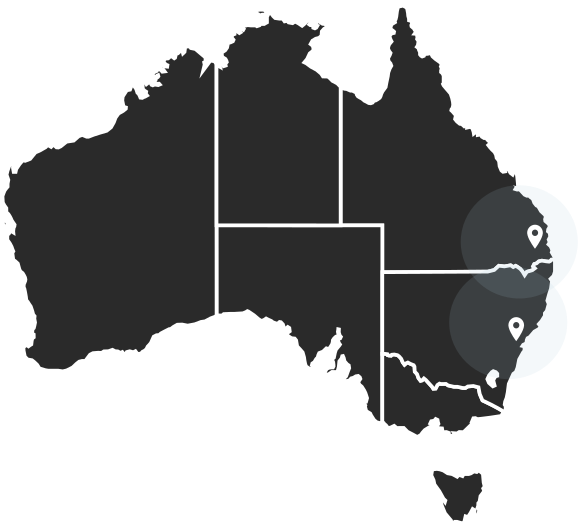
All About Lifting & Safety constantly strive to deliver the best possible service to our clients on time and keeping their compliance requirements in-date, All About Lifting & Safety have partnered with the following companies and industries;
- Lend Lease road and building projects.
- Building construction companies.
- Civil construction companies.
- Processing mills.
- Councils.
- Utility companies.
- Tunnel boring companies.
- Road and case boring companies.
- Pipe line construction companies.
- Piling companies.
- Major crane companies including off shore.
2. Management Systems
All About Lifting & Safety have developed sound management systems to reflect the work we do and are constantly applying all observations to improve our own work place. We stay up to date with current Australian Standards within industry and apply those standards to all of our clients work sites to better inform them of changes required. We maintain the following management systems;
- Safety and risk management system - constantly updated.
- Environment Policy.
- Quality Management System – NATA.
- Insurances – Public, General & Product Liability to $20,000,000.
3. Customer Service and Market Response
Relationships and Communication are very important to our business. We maintain good relationships with clients by being available for anything at any time and adopting the attitude of nothing is too hard.
Many times we have conducted onsite repairs of equipment to get a client back into service at very short notice. Our clients rely on us to complete tasks or fill orders at short notice.
All About Lifting & Safety realised there is a gap in the market due to lack of service and commitment to customer requirements, as such, our goal is to fill that gap.
Frequently Asked Questions
- What Does Working at Height Mean?
Generally speaking a person is considered to be working at height, and requiring height safety gear if their work puts them at risk of a fall that could result in injury to themselves or another person at the workplace.
Circumstances of working at height include situations that require a person to work:
- On, or in the vicinity of, an elevated structure above ground/floor level
- On, or in the vicinity of, ground level where they could fall into an opening in a floor or a hole in the ground.
The specific requirements for height safety gear depend on your industry, workplace and legislation in your state, territory or country.
All About Lifting & Safety offer a large range of working at height solutions, products and services.
- How Can We Manage Working at Height Risk?
It’s important to understand your workplace health and safety responsibilities and regulations for the location you operate in. This knowledge will inform how to identify your working at height risk and what height safety gear may be needed.
Typically, under WHS Regulations, a duty holder is required to:
- identify reasonably foreseeable hazards that could give rise to the risk
- eliminate the risk where reasonably practicable
- minimise the risk, where the risk can’t be eliminated, with control measures in accordance with the hierarchy of control
- maintain the control measure and ensure it remains effective in minimising the risk.
Depending on the scenario, height safety gear may be identified as an appropriate control measure.
For more information on height safety gear, speak to the lifting and safety equipment experts All About Lifting & Safety.
- How Can We Identify Fall Hazards?
There are some key indicators that are associated with fall hazards, and will lead to the need for height safety gear.
To identify fall hazards in the workplace you will need to focus on all locations and tasks that could cause injury due to a fall.
The locations may include areas where people work, but also areas used to access parts of the workplace.
You should also focus on any structure or equipment that is being constructed or installed, demolished or dismantled, inspected, tested, repaired or cleaned.
Other locations to pay particular attention to include fragile surfaces, such as brittle, damaged, worn or lightweight roof sheeting and skylights.
There may also be locations at your workplace where there is a potential for a ground or floor to give way, or there is already an open pit, hole or shaft.
Additionally, inspect elevated work levels or anywhere where a person is required to be near an unprotected open edge.
It’s recommended that you obtain formal information and advice about fall hazards and risks relevant to your work practises and location. This is often available from regulators, industry associations, unions, and safety experts such as All About Lifting & Safety.
- What Kind of Height Safety Gear Do I Need?
After identifying the specific fall hazards at your workplace you may identify the need for height safety gear to minimise risk and injury.
The specific gear you need will depend on your business, industry and location, but the most common height safety gear is a safety harness and fall arrest system.
All About Lifting & Safety stocks a full range of lifting and safety products and can advise on the best equipment for your needs.
- What Is A Fall Arrest System?
A fall-arrest system is what equipment is put in place to safely stop a worker falling an uncontrolled distance. It is designed to reduce the impact of the fall, where other controls can’t be put in place to eliminate the fall risk.
The height safety gear used in a fall arrest system must be high quality and meet relevant safety standards.
It is often comprised of equipment such as, but not limited to:
- Anchorages
- Lifelines
- Safety harness
- Lanyard of fixed length
- Rope grabs
- Wire grabs
- Snap hooks.
The fall arrest system needs to be:
- the right equipment for the specific circumstances and location.
- properly installed, used and maintained.
- In safe working condition.
- capable of managing the weight and the force applied as a result of a person’s fall.
- able to ensure the person travels the shortest possible distance before having the fall stopped.
Contact Us Today
With a combined 80 years of experience in the lifting & safety industries, All About Lifting & Safety are the experts you can count on. We are ready to help with supplying, installing, repairing, testing or servicing your lifting, height safety & confined space equipment.
Get In Touch
Send us a message below and let’s have a chat about what you need.